
Travel
Il Borro
Becoming a little more myself, inside a place.
- Date
- 22 October 2026
- Subject
- Travel
- Reading
- 12 min read
- By
- Gülen Ekim
When the great iron gate opened, a narrow road appeared before me. Cypress trees lined both sides, reaching up toward the sky; the space between them carried my gaze to the old stone building at the end of the road.
I love the slender, elegant, dark green stance of cypresses. They are like punctuation marks within a landscape. Without telling me where to look, they guided my gaze, as if holding upright a long thought of mine stretched between sky and earth.
As I moved between them, I sensed that the road would not lead only to a building. With every step, a distance opened between the day I had left outside the iron gate and the one about to begin. I was the same person; my phone, my work, all the sentences racing one another in my mind were with me. Yet along that narrow road, their voices seemed to fall behind, little by little.
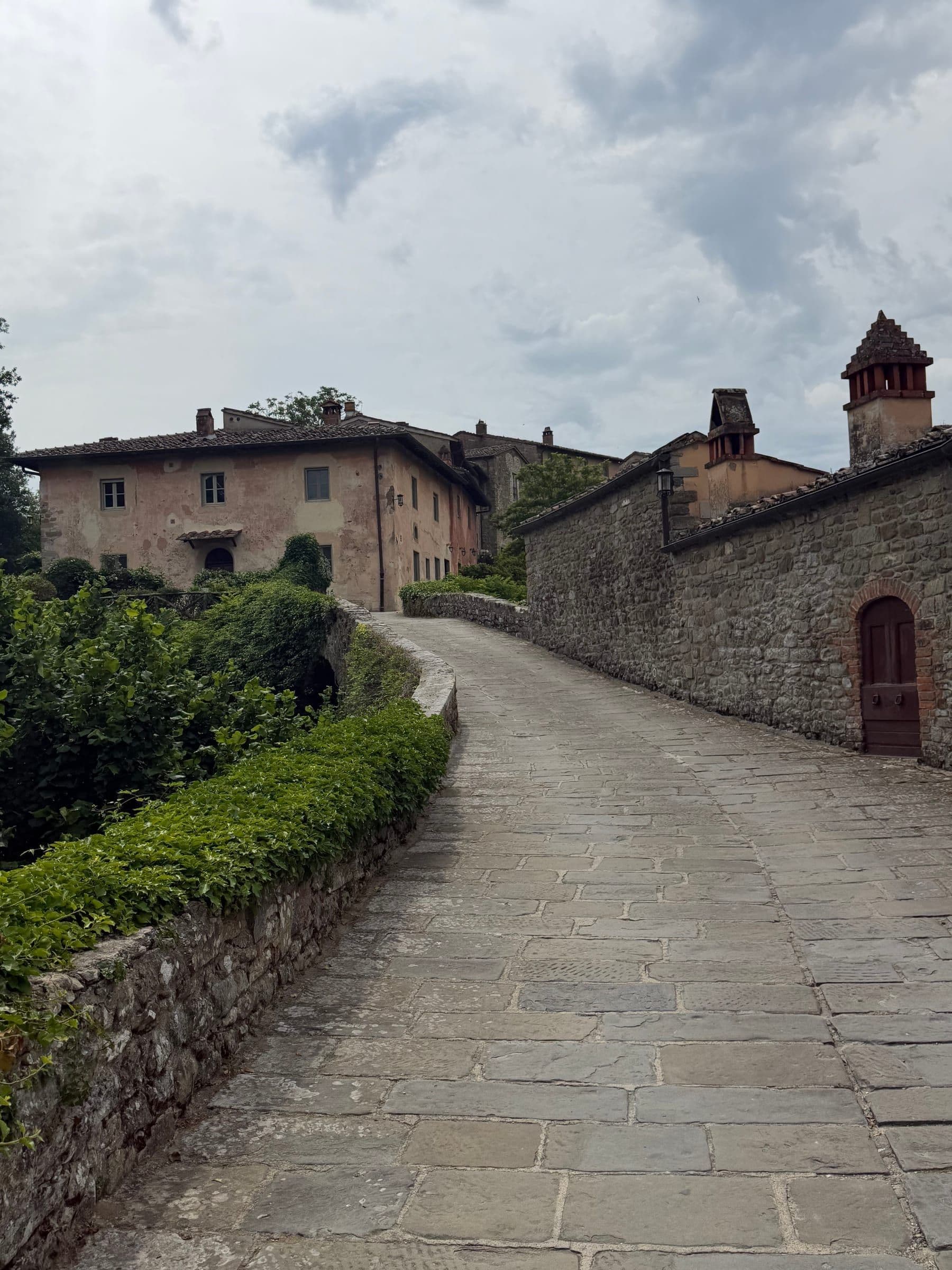
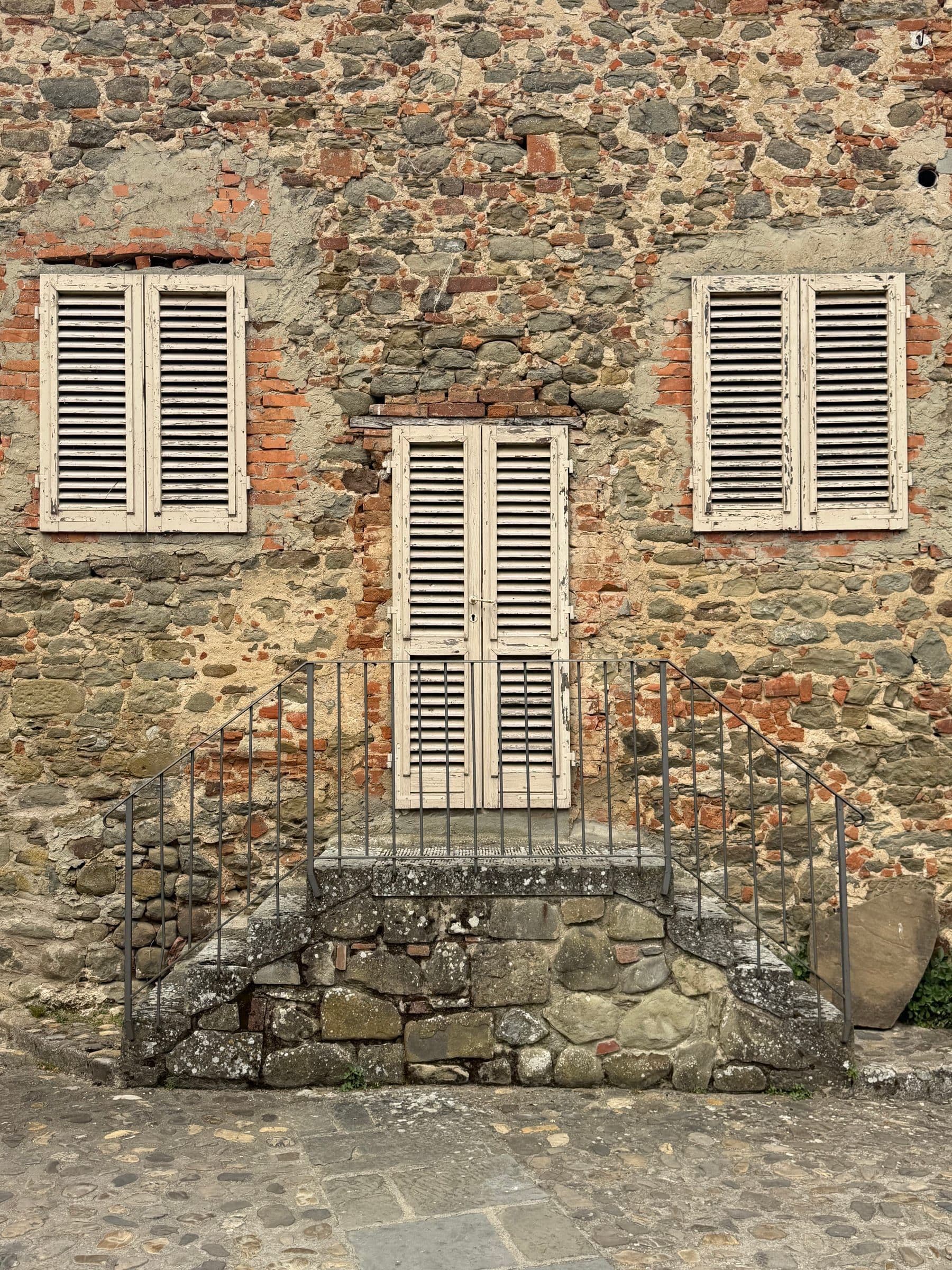
As I drew closer to the old stone building, all the small details I had glimpsed between the cypresses began to open up before my eyes. The wall was not a single colour, for instance; some stones held the light on their surface, others kept it deeper inside and stayed cool. When I reached the front of the building, my gaze wandered through the gaps between them, along edges softened by time. The silence that had opened in me along the road now had an answer here, on the face of this old building.
Whenever I spend time in a space, I always wonder what its materials are saying to one another. Here, my eye was first caught by the way the stone settled into its surroundings. Between it and the earth, the trees and the road that passed before it, there was a closeness that had lasted a long time. I could clearly see where the building ended, yet in my mind I could not draw the line where its belonging to this place ended.
As my gaze moved from one detail to the next, my urge to form an opinion about it slowly gave way to curiosity. I found myself thinking less about how this surface ought to be, and more about how it had come to be this way, and what lived experience it held.
In the shadows between the stones lay the quiet of having belonged to a place for a long time. The wall of the old building had found another meaning in every life that passed before it. For some it had been the edge of home, for some the first sign of return, for others a surface they passed in the shade of every day, one they had grown used to. While the meanings given to it changed, the stones stayed where they were and became a place where people could lean their own stories.
What had been added to it, what had been placed in front of it, the glances turned toward it or away from it over the years… None of them could describe the whole presence held in that wall of the old stone building. This building belonged there even when no one was looking. Without waiting for someone to rediscover it, without needing to be fixed.
Standing before it put me at ease. In an age when we try to bring out the value of everything through some intervention, I saw in the wall of this building the grace of growing old. The passing years had settled onto the surface of those stones. Removing them felt like removing part of their beauty too. The longer I looked, the more I thought about how little tenderness I show the marks time has left on me. Yet what carried me into deep thought the moment I saw it was that you could still see life had touched these stones.
Once again, it reminded me that care is sometimes about no longer searching for what is missing in something, and making room for the life it carries.
With this thought, I set off into the village. Where the road curved, the landscape opened up little by little. Distant hills appeared above a rooftop, and a little further on my eye caught on pink flowers. They had grown beside the stones, spilled over, and mingled a little with the view before them. The faces of the old houses seemed to hold a joy that had no wish to be taken seriously.
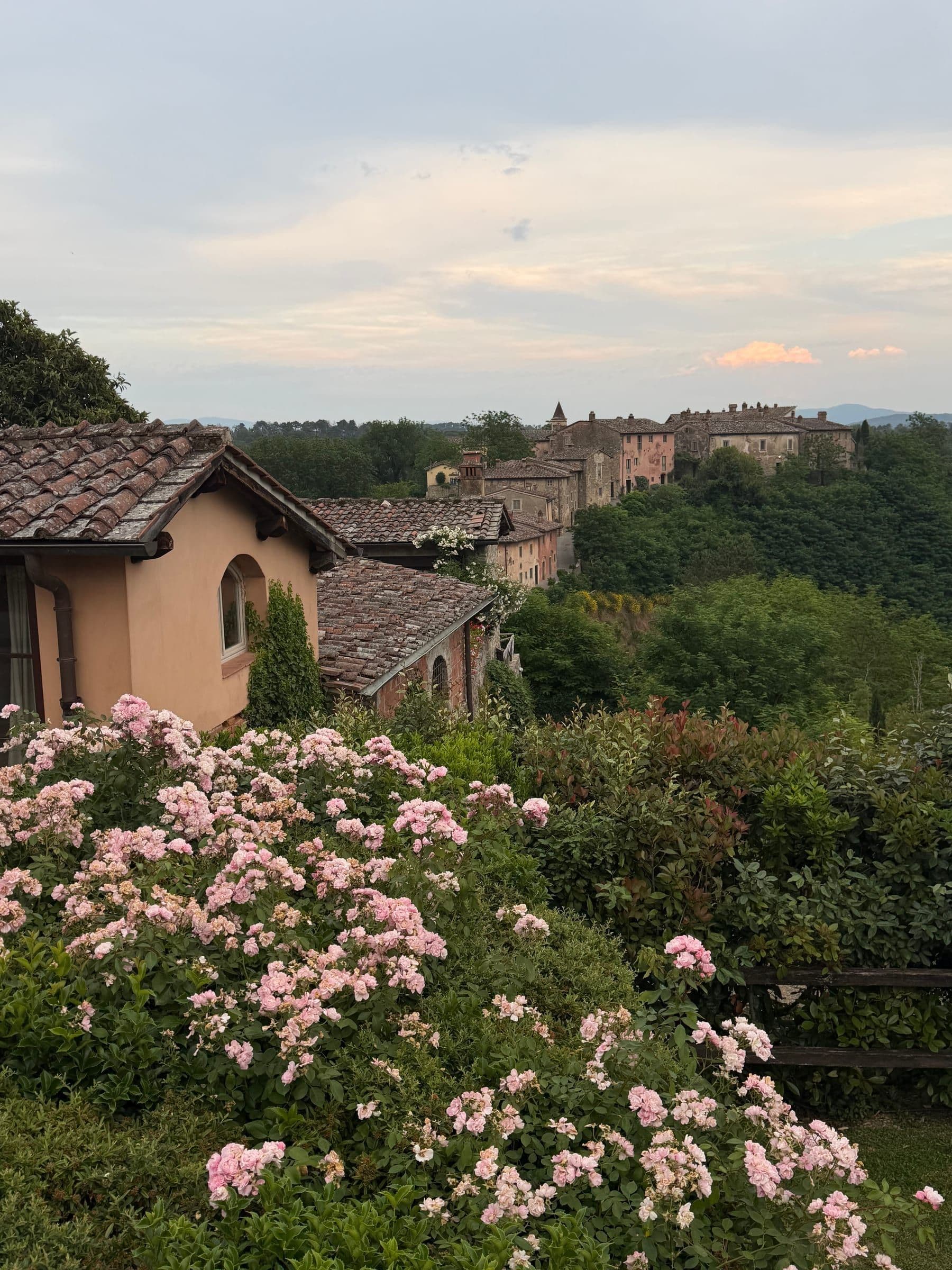
Wooden shutters, roofs close to one another, narrow passageways, now and then a coloured façade… In some streets the houses leaned so close that the sky left between them looked like a thin strip of fabric. Where stone met brick, my eye followed the traces of decisions made long ago. In the same street, several different hands and several different eras still stood together.
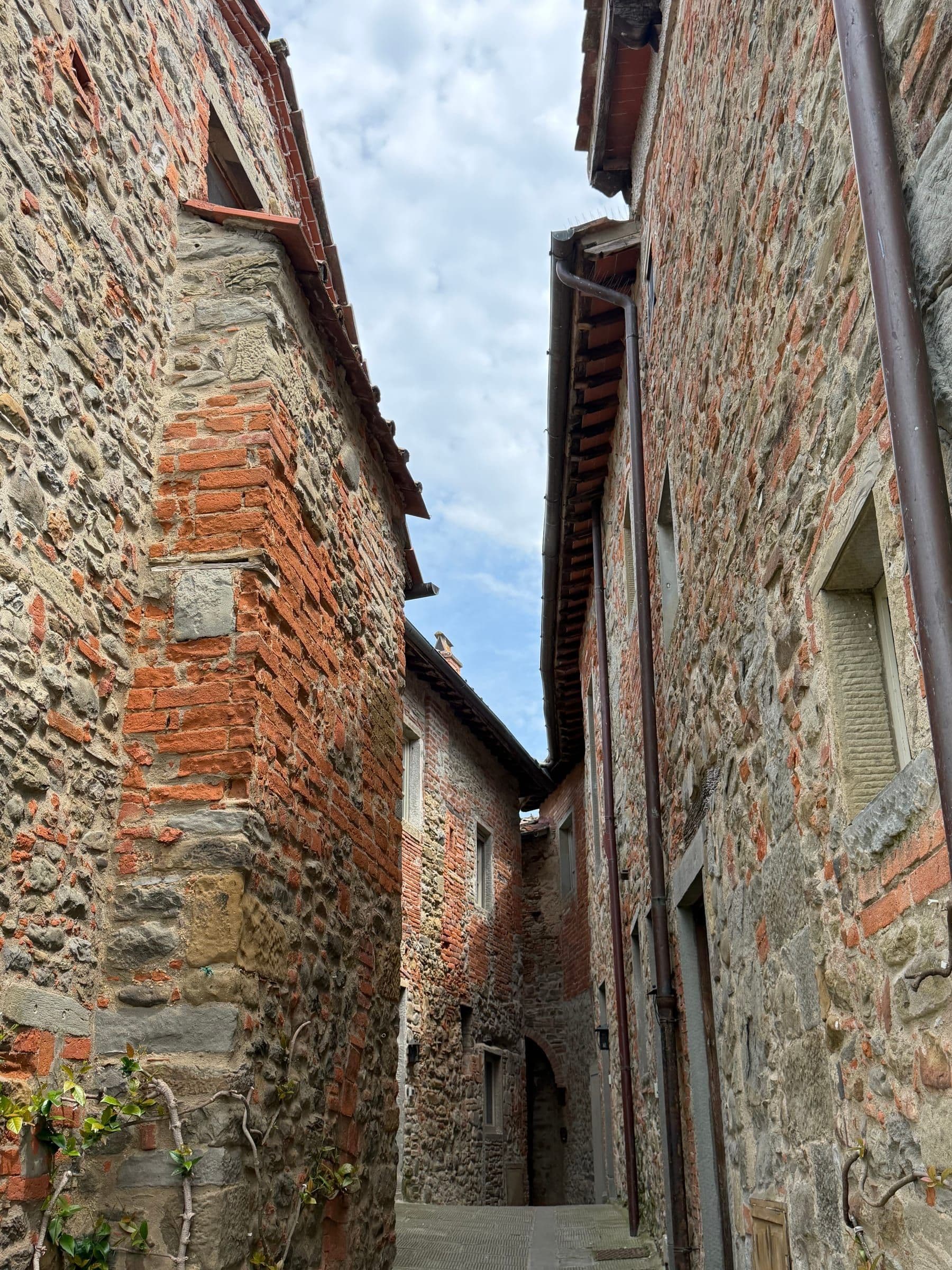
The beauty of Il Borro could not be gathered in a single glance. As I walked, another detail appeared, and when I turned back, the place I had just passed had changed.
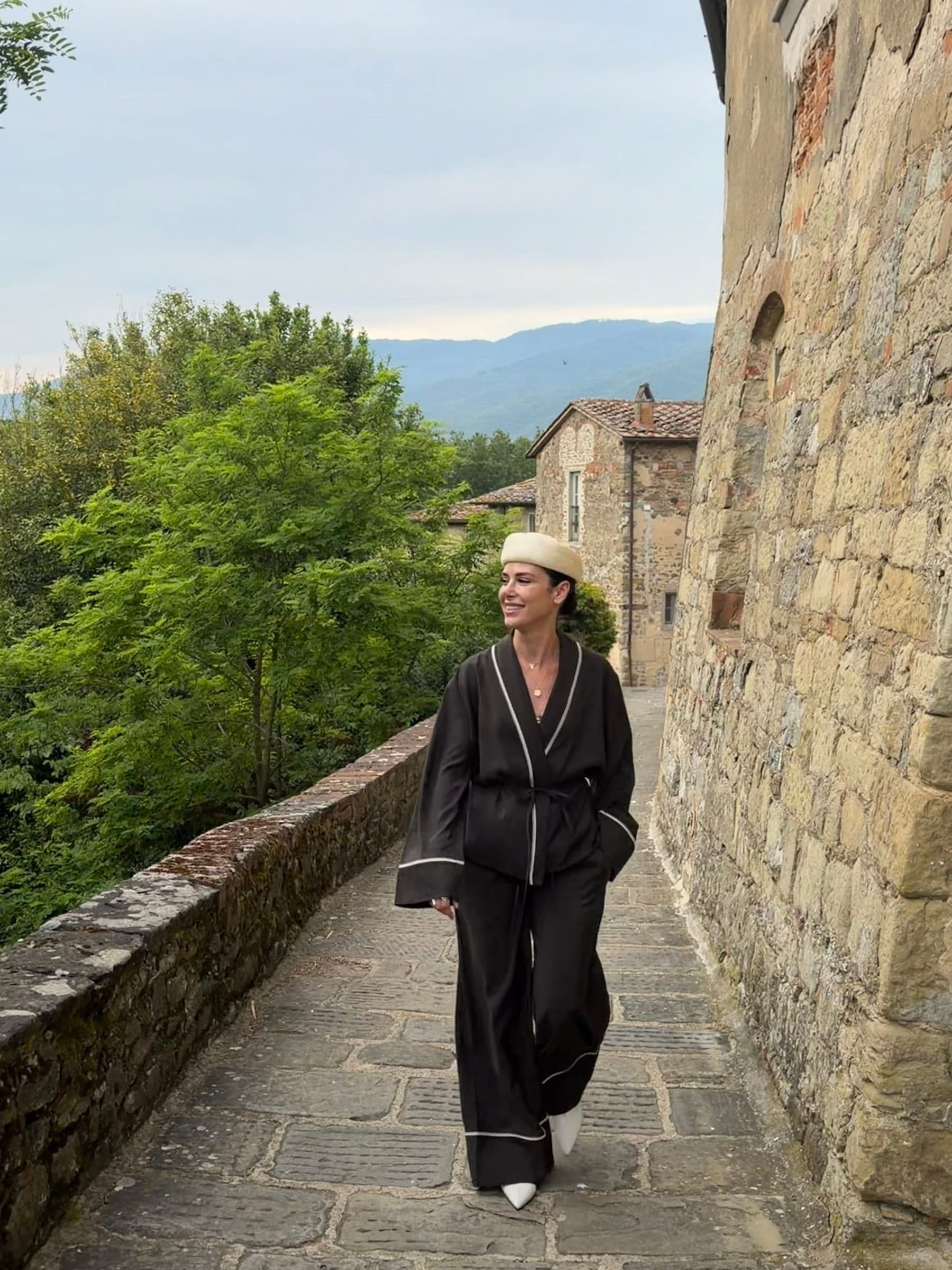
Here, I let my eyes linger on the same view for hours.
The time I had just seen in the stones of the old building now met me in another language, in the doors of the houses. The places where the wood had darkened, the slight hollow of a threshold, the marks gathered around the ironwork…
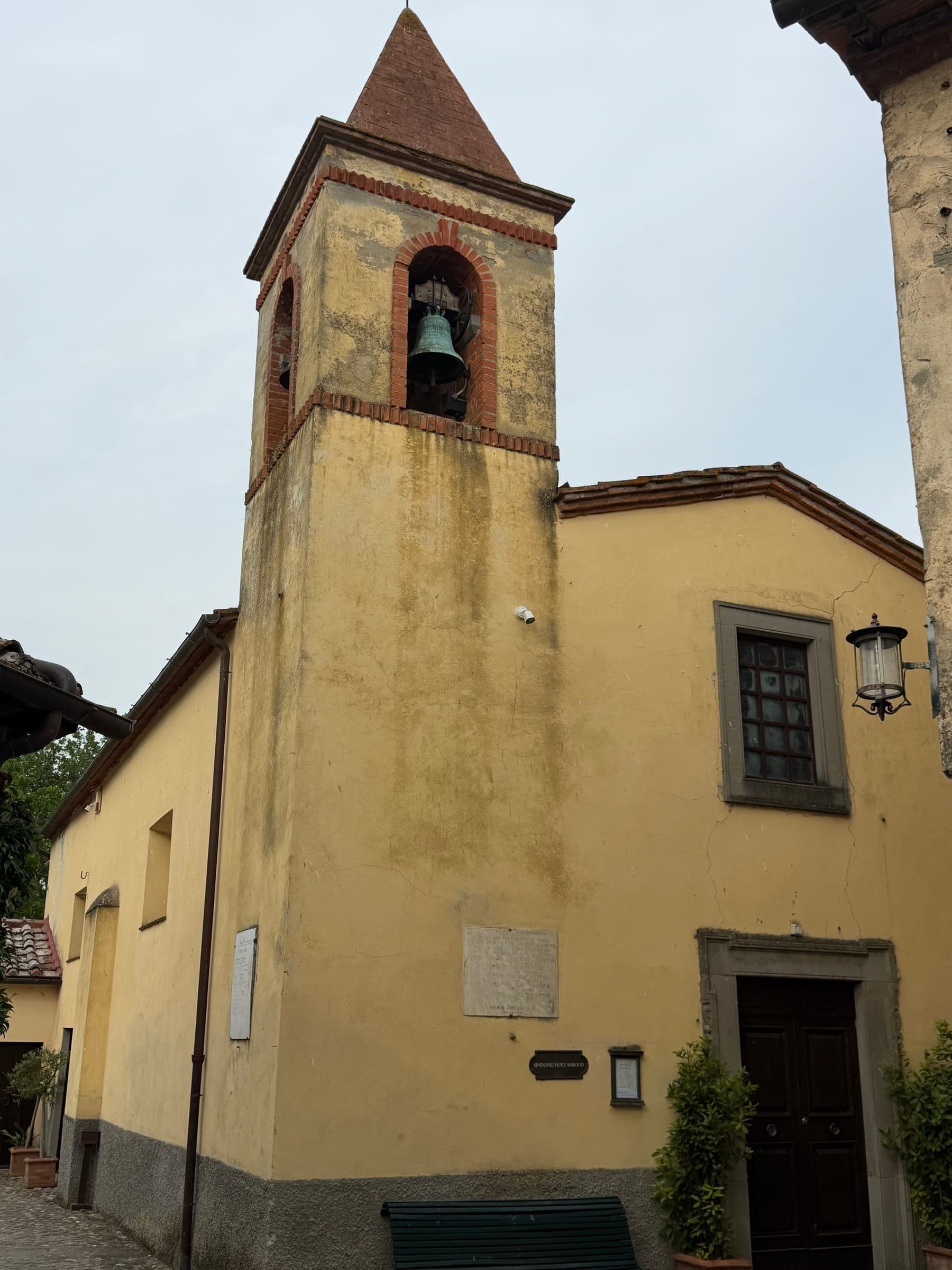
Who had pulled these doors shut behind them and left? Who had waited a moment to hear a voice from inside? Had the hand that reached out with the relief of coming home touched the same place as the hand that paused one last time before leaving?
I could never know. But the existence of lives I did not know made those doors more meaningful to me.
When I touched the wood, for a moment I felt like someone that door did not yet know. Among all the arrivals and departures before me, my small visit had now been added too. Whatever I had carried there with me that day, this threshold might long since have seen its like.
People before me had also wanted to return somewhere. They had hoped someone would be inside, had left without being able to say something, and had begun again the next morning.
There was an unexpected closeness in knowing that my own feelings were not new to the world. As I walked, thinking about that closeness, the writing above another door stopped me:
Botteghe artigiane animate in miniatura.
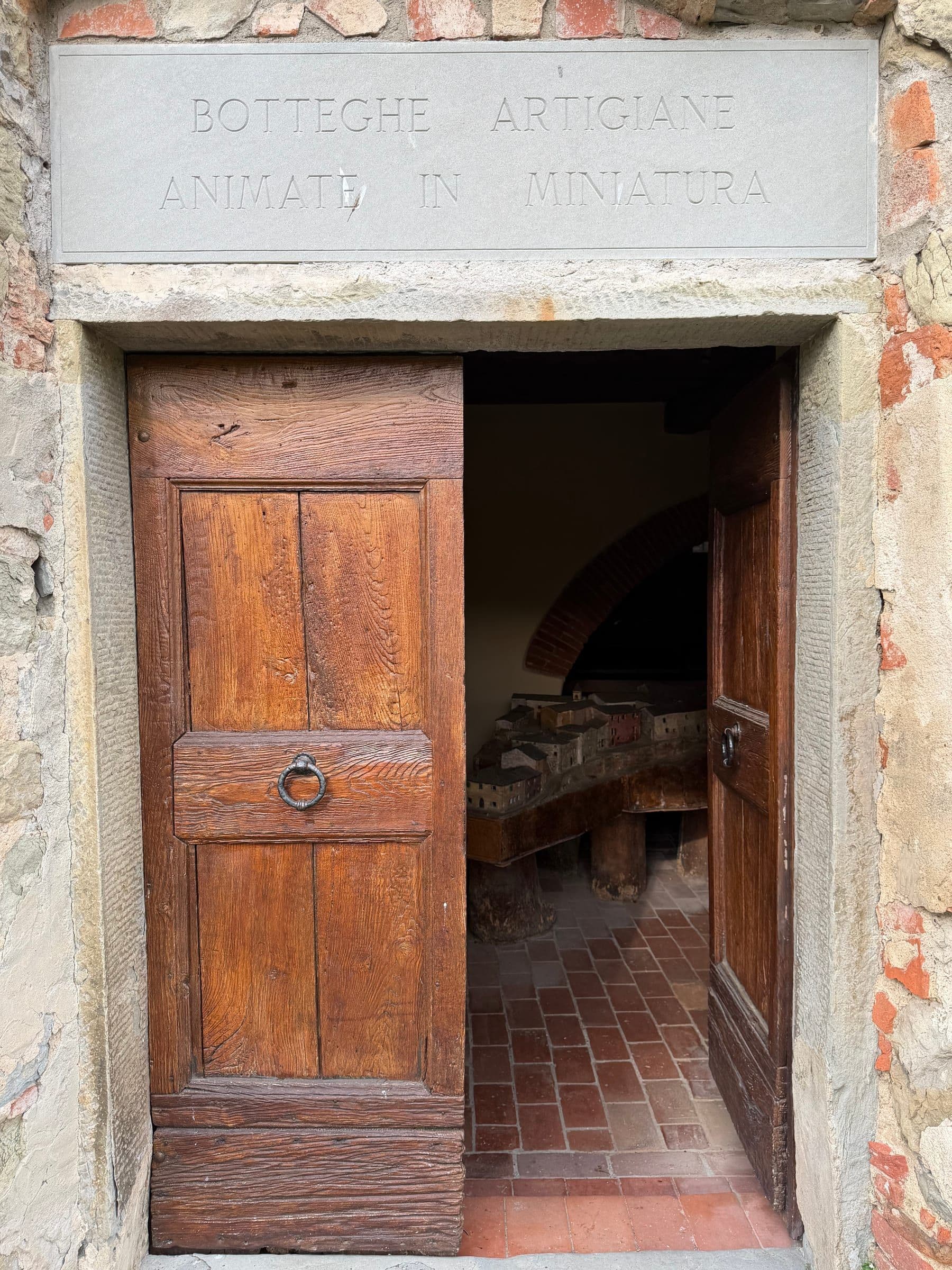
In English: “Artisan workshops brought to life in miniature.”
But in that moment I did not know what it meant. Still, I could not stop looking.
I looked at the way the letters sat on the surface, the space between them, the small place the writing took up above the door. Someone had chosen these words, put them there, and wanted them to be seen before anyone stepped inside.
Who was that person?
When the sign was first hung, had they stepped back a little to look at it? Had they said it should be a little higher, or set it in place by hand and gone back to work? Who were those words calling to? A passer-by, a curious child, someone who would understand the worth of the work done inside?
Because I did not know its meaning, I could not use the writing up at once. Before it became a piece of information, I saw it as an intention someone had left there.
Above the door, a small decision made years ago could still stop someone in their tracks. That day, that someone was me.
Looking at the miniature world inside, the feeling stayed with me. Tiny houses, workshops, everyday lives… It moved me that someone had paid such attention to the ordinary days of other people.
If my own life were built like this, by which details would it be recognised?
There would certainly be a table covered in material samples and notes. A few open files, a to-do list I start anew before finishing the last. And I would want a table set for long conversations.
Then I laughed at myself. Even in my miniature life, the first thing I had put in place was my desk.
After that tiny world, I wanted to see further beyond this place. I took a bicycle from the hotel and began to open out from the details of the village toward the landscape around it.
Pedalling along the road lined with cypresses, this time I was passing between the trees I had looked at on my first arrival. They appeared one after another, passed beside me and fell behind. The line of the road, so calm from a distance, turned into distances I felt in my body with every small slope while I was on the bicycle.
There is a difference I love between getting to know a place on foot and getting to know it by bicycle. On a bicycle, the landscape comes toward you a little. While you choose what you want to stop and look at, the air touches your face, and your body joins in the discovery. That day, my curiosity had two wheels.
The road carried me to the vineyards.
As the rows of vines drew closer together in the distance, the green corridors between them pulled my gaze down into the earth. They had been planted in order, but the leaves had added their own small objections to that order. One reached out in front of another, a branch spilled into the gap, a leaf turned its face to the sky.
The geometry of the vineyards and the freedom of the leaves stood side by side.
I loved looking at that togetherness. It is one of the things I look for in a design too: an order left open enough for life to settle into it.
Light was caught in small pieces in the curves of the vine leaves. The green was not a single surface; it deepened along the vein of a leaf, thinned at its edge, and turned into another colour with the brightness passing behind it. What I called a landscape from afar was, up close, thousands of small pieces, each catching the light in its own way.
Cycling between them, I thought about how wide a life something that fits into a glass at the table has here.
Then I came to where the horses were.
When I saw them, I slowed the bicycle. On the chestnut one, the light rested broadly on its body; the dark horses blended into the shadows of the wooden shelter, and the white one drew my gaze to itself within all the green.
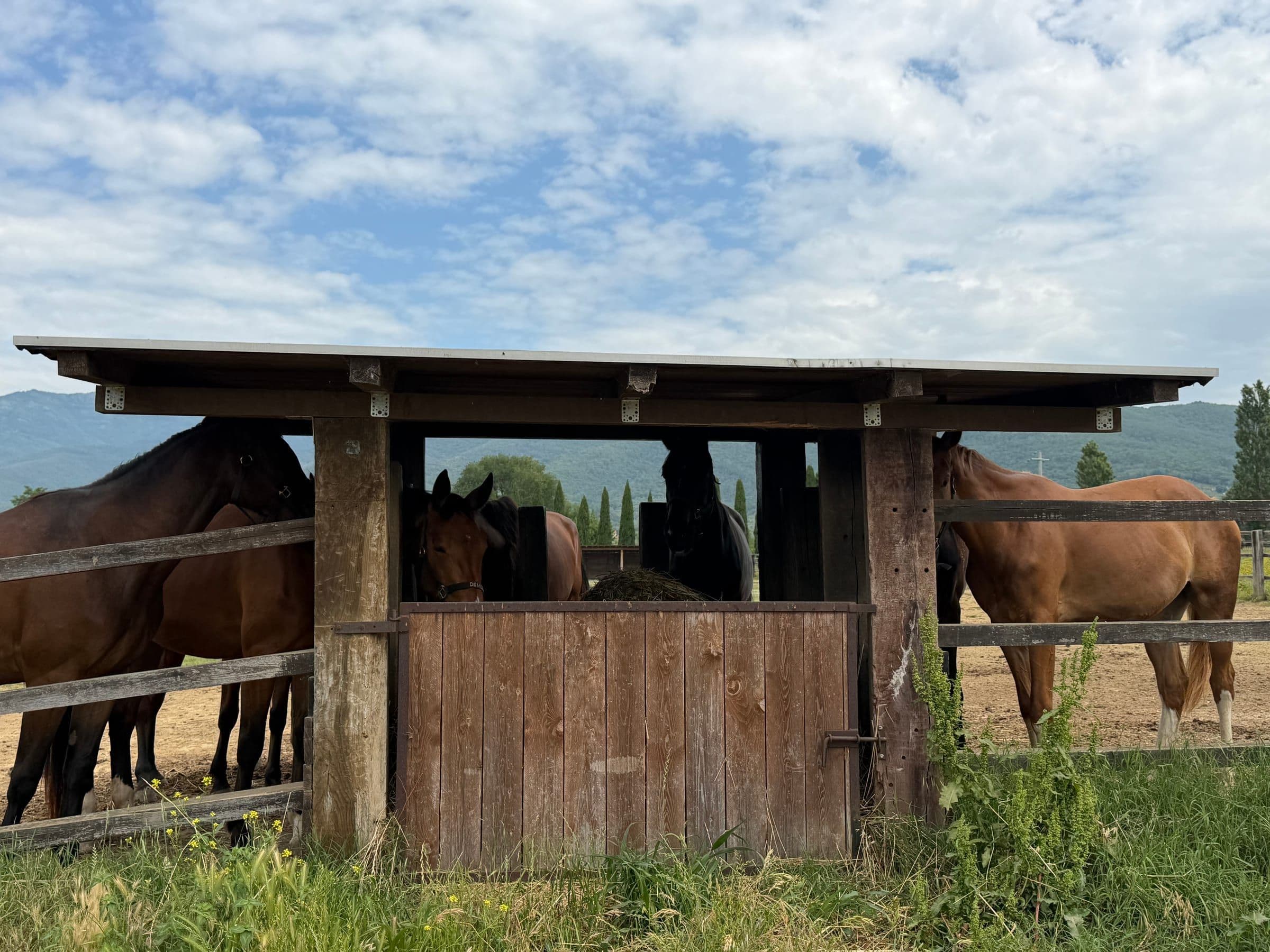
Beside the horses, there was another way of looking. I could look at a tree or an old door for as long as I liked. Here, though, the living being in front of me also sensed its surroundings and moved its own attention from one place to another. With the turn of its head, the direction of its ears, its gaze toward something I could not see, it opened a side of the landscape that had nothing to do with me.
We were in the same place, but we were not seeing the same world. While I looked at its beauty, perhaps it was trying to get to know a new stranger.
I wanted to watch the horses without placing them inside a story of mine. The line of their necks, the disorder of their manes, the way they stood side by side, the differences in their bodies. My habit of drawing a meaning for myself out of everything rested a little in their company. Beside such a creature, one could feel a closeness without fully understanding it.
When I got back on the bicycle, I thought that discovering is not the same as learning everything. Sometimes your curiosity about a place grows even larger after what you have seen.
That is how it was in the wine cellar, too.
Brick arches stretched one after another, and the barrels on either side lined up toward the depth of the corridor. The light lingered for a moment on the inner face of each arch, then passed on to the next. The repetition of the ceiling was like a quiet measure moving through the space.
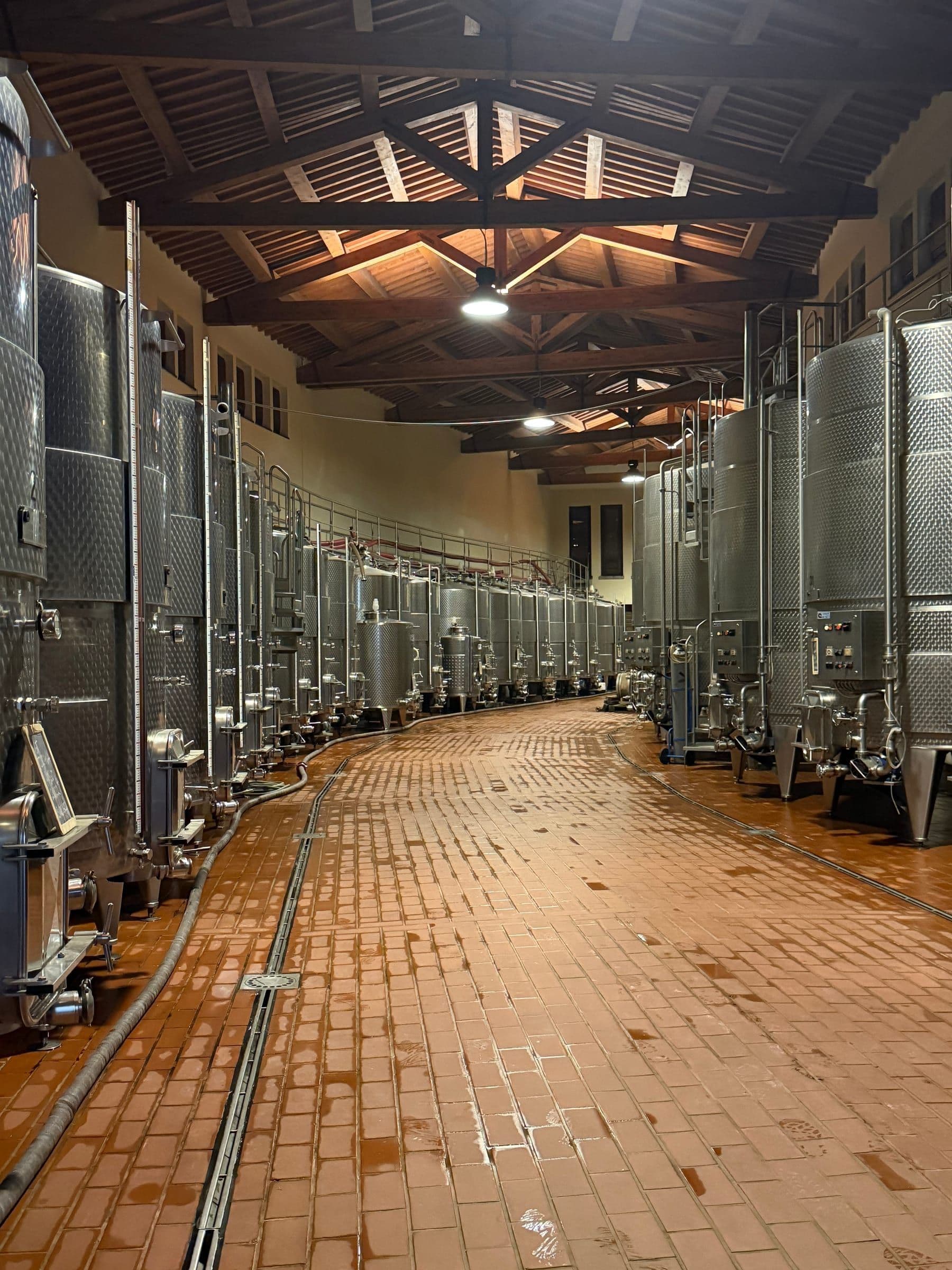
The light I had seen on the vine leaves outside had been thoroughly filtered here, and stayed close to the walls. Everything that opened to the sky in the vineyards turned inward in the cellar.
The rounded bodies of the barrels, the tones of the wood, the dark hoops holding them together… Here, the presence of all those wines not yet drunk filled even the air that seemed empty.
I liked thinking about what comes before a glass of wine. The life that begins in the earth and reaches into the leaf, the fruit, all the way into this dim space. Something we finish in a few sips at the table could have travelled such a long road before reaching us.
After leaving the cellar, I looked at my surroundings a little differently. The vineyards were no longer just rows that look beautiful from a distance. Above and below the ground, there was a whole here that carried on without seeing itself.
When I sat down to dinner in the evening, everything I had seen during the day came to the table with me.
Sitting at the table at Il Borro, I felt as if I had stepped into a wider place within the day. That familiar feeling of narrowing toward the next hour disappeared.
When I looked up, light wooden beams repeated across the ceiling, and the line of the sloping roof carried my gaze into the space. Stone surfaces, white tablecloths, soft yellow light… The world my eyes had grown used to outside carried on around the table.
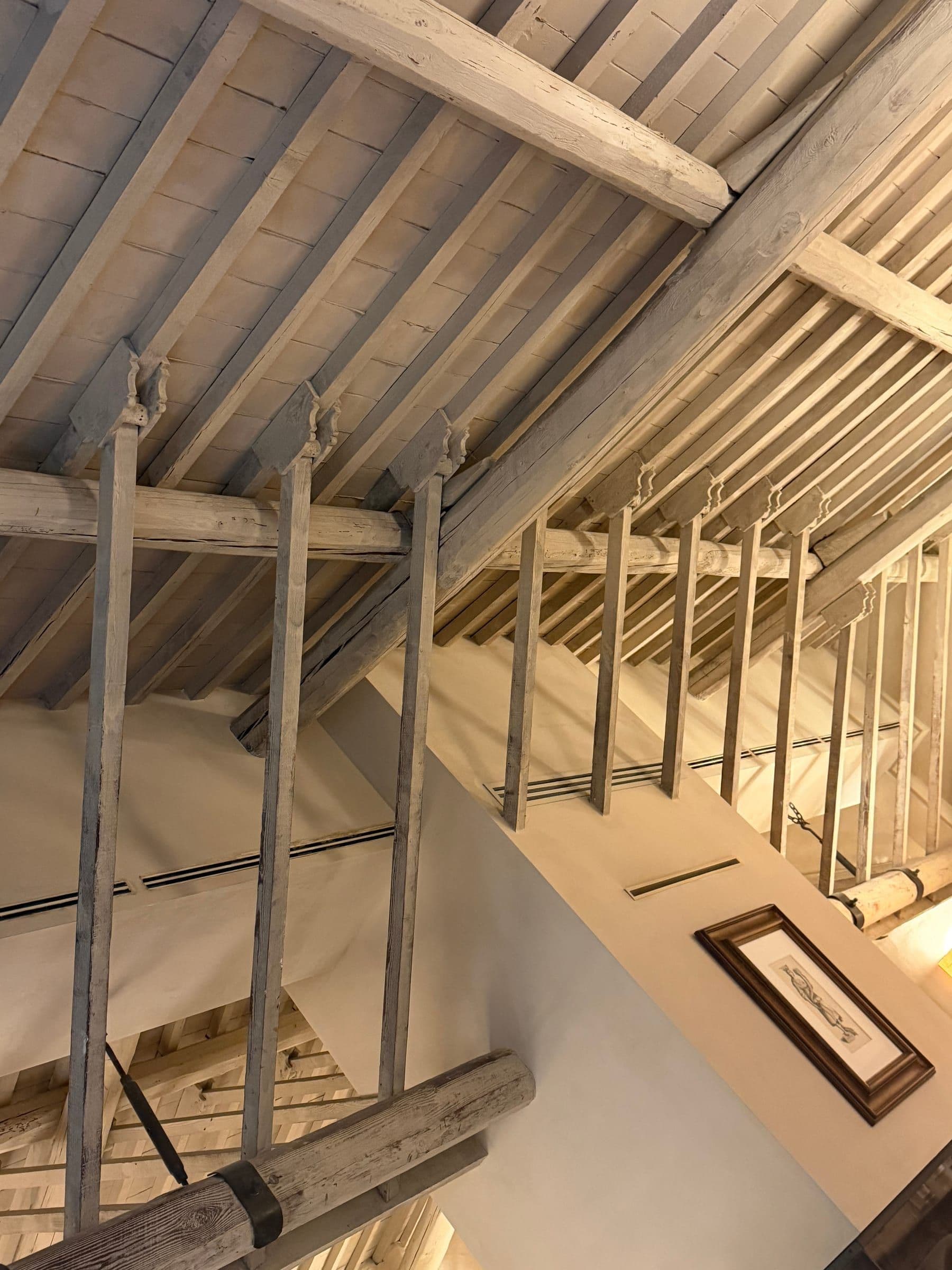
Then the plates arrived.
Some dishes I want to look at for a long time before the first bite, to photograph them in my mind. I realise I am standing before a beauty that, a few minutes later, I will remember only by the taste it leaves behind.
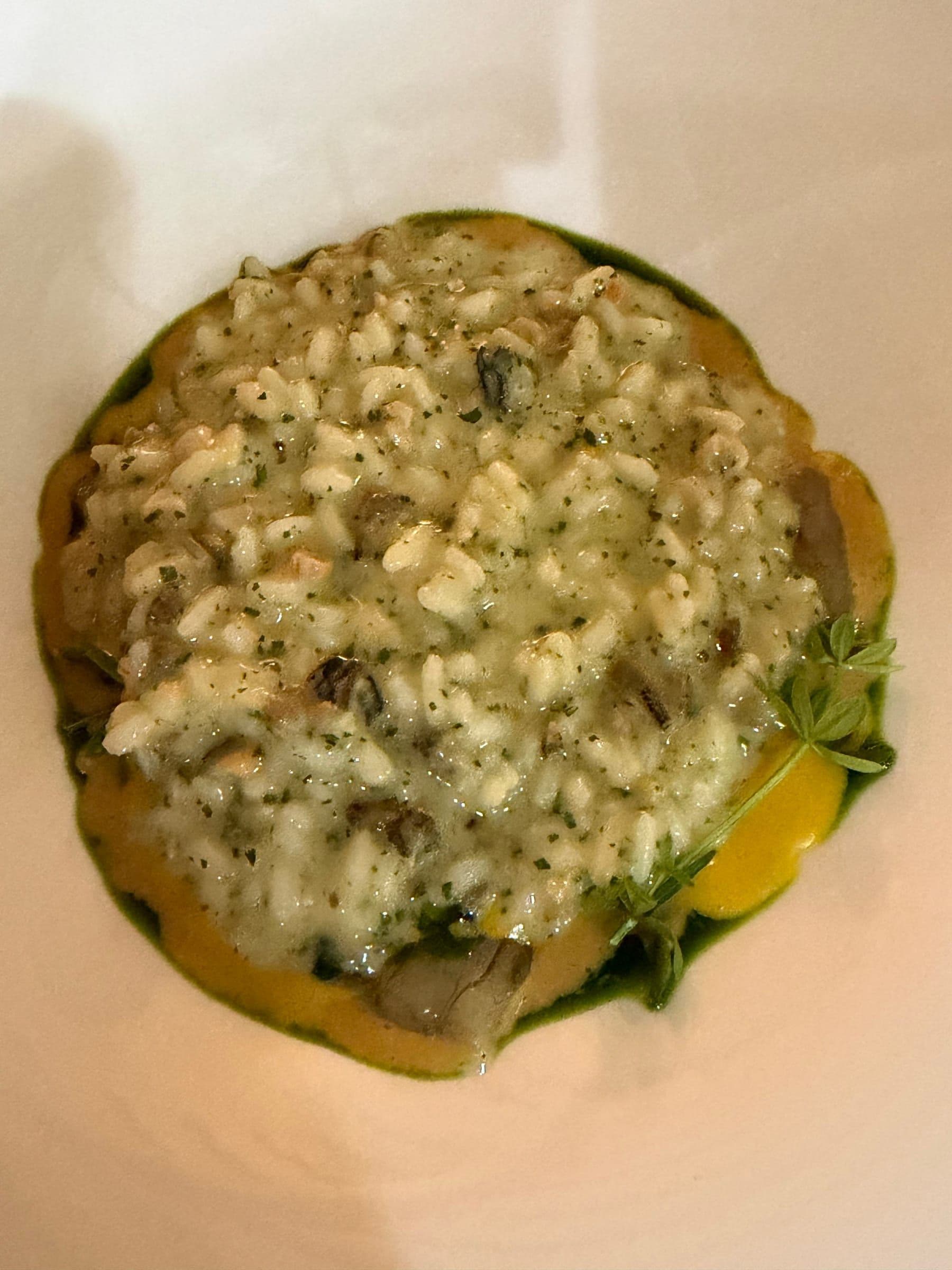
As much as the taste of the food, I remember the conversation that formed around it. A short remark with the first bite, then another subject, then attention returning to the plate… Conversation and food did not have to wait for each other’s turn. As the dishes kept coming and the conversation grew longer, the evening made a little more room for us.
The closeness to the land that I love in Tuscan cooking could be felt here. Olive oil, wine, vegetables, homemade pasta; they came to the table like different expressions of the same surroundings.
What I was eating felt like a continuation of the place I was in.
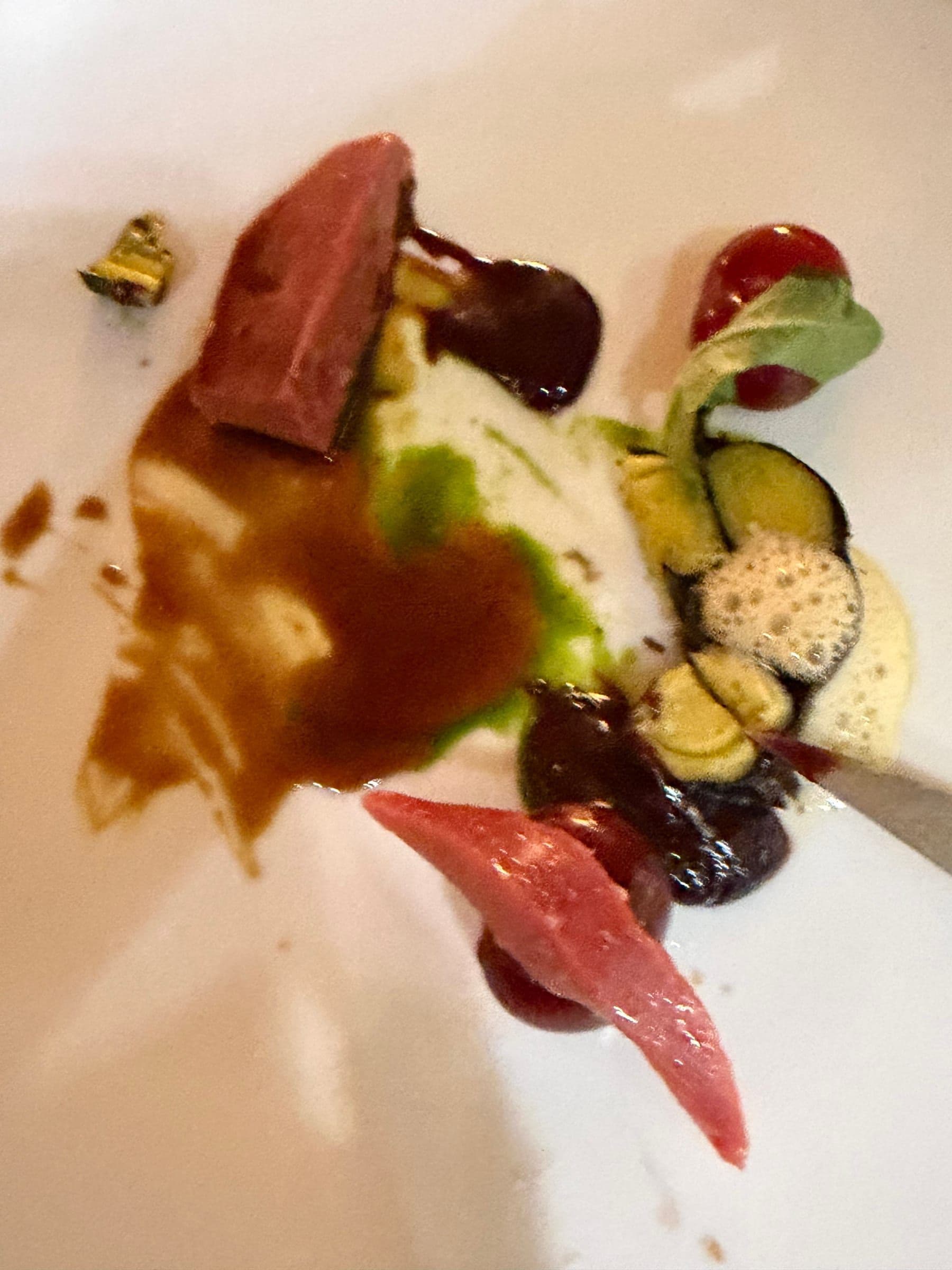
I had passed through the vineyards. I had seen the barrels in the cellar. Now, as I picked up my glass, the parts of the day I had thought were separate came closer together. I thought that a space, too, can be tasted like this. That evening, the place I saw with my eyes had an answer on my palate as well.
The harmony I felt at the table was related to the harmony I always look for in design. In a well-made room, every material makes itself heard, but they do not all try to stand out at once. The warmth of one carries the hardness of another; an empty space gives breath to the object beside it.
Here, too, flavours left room for one another.
And I relaxed within that room.
There was no need to describe the food right away, nor to bring the conversation to a conclusion. A sentence could be left unfinished, we could fall silent for a bite, then pick up where we left off. When silence came to the table, no one had to attend to it; it sat for a while, then rose of its own accord.
In one of those silences, I wondered whether this might be what trusting your own taste feels like. At a table, in a space, beside a person; trusting a little that every detail can be understood without being explained…
When I left the table and stepped out into the street again to return to my room, the daylight had long since withdrawn. The ease I had felt at the table began to walk with me.
The face of the village I had seen by day had now drawn back. The yellow light did not fall evenly on the stones; it lit a ledge and left what lay behind it in darkness, opening small depths in the surfaces that I had not noticed by day. The street came closer where the light reached, and moved away again a few steps further on.
The doors were closed, but the village did not seem empty. It was as if life had been taken indoors, and only its warmth had stayed outside.
The sound of my heels seemed to walk a few steps ahead of me in the street. Before turning a corner, I wondered what lay beyond it. The road that was part of the landscape by day showed only as much as I stood in at night. To see further, I had to take a few more steps.
That night, I liked walking without knowing everything in advance, together with the dark and the sound of my own footsteps.
When I look at the photograph of me in my white hat, I still remember that feeling in my heart. Among buildings hundreds of years old, my thoroughly contemporary choice of outfit. Sometimes I love that history makes room for small inconsistencies like this.
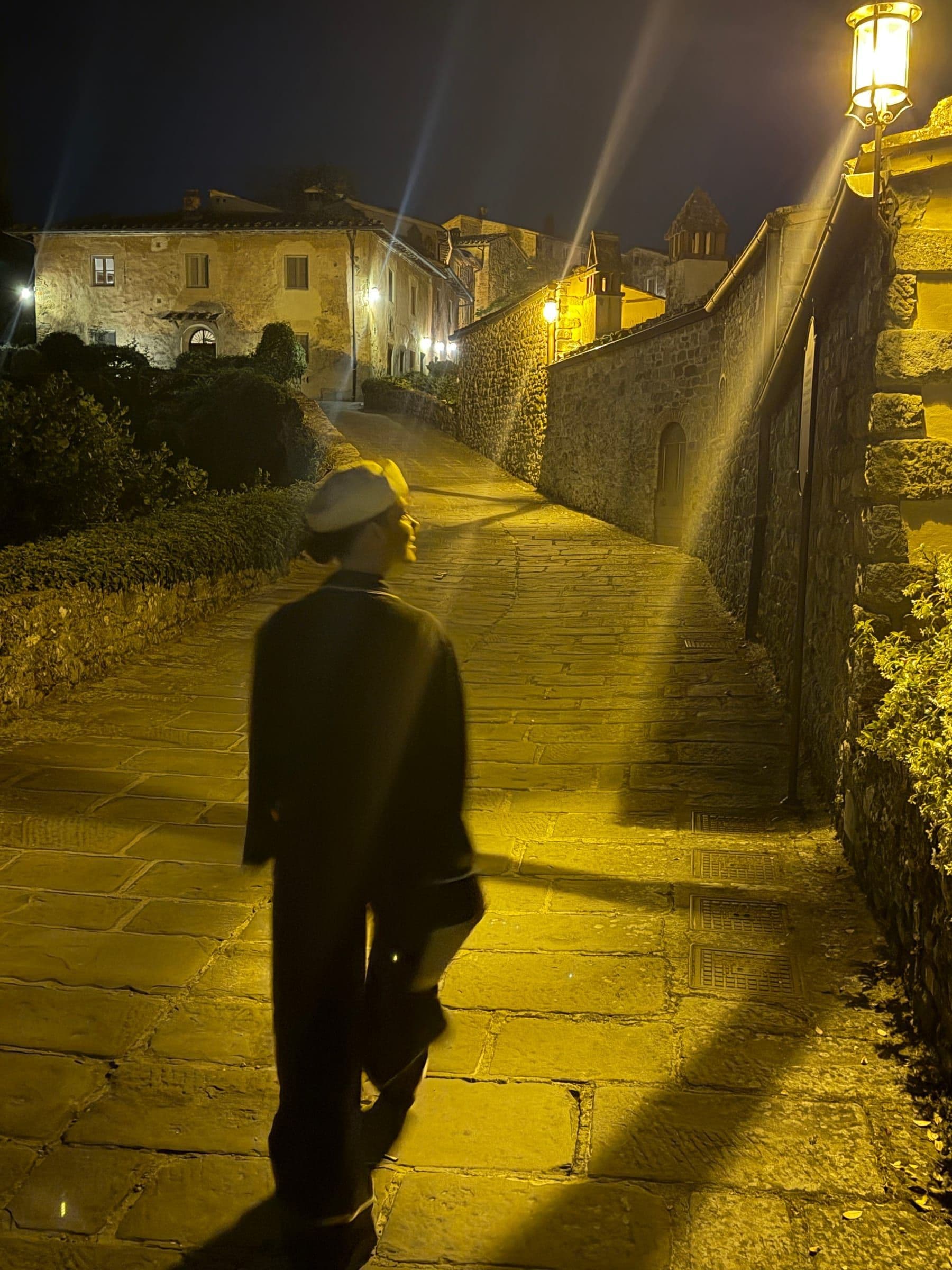
That night I was not managing anything. I had surrendered to the calm of the village. I was not choosing a material, not solving a detail, not setting out the order of the next day. The part of me that always runs ahead of me was, for a while at least, walking at my pace.
In the morning, the birds woke me.
It was such a crowded, intermingling chorus that it was as if the whole garden had found something to say at the same moment. One began before another had finished, a thin voice rose in between, someone else answered from far away. I listened without opening my eyes. Knowing that the world had begun its own joy long before I started my day made me feel lighter.
With the light coming in between the curtains, the room took on another mood again. Surfaces that had grown heavy in the night felt lighter. The green outside began to speak with the wood inside.
I stayed in bed a few more minutes. I was not a missing voice in the birds’ chorus. I did not have to join in, keep up, or do anything at all. Simply listening was enough for me to exist within that morning.
The rain that fell before I left was like an unforgettable farewell scene.
It was not a fine, gentle rain. It filled the pool all at once with countless small splashes, its force setting the surface of the water in motion. Every ring the drops opened merged into another before it could close. The outlines of the trees softened more and more within the downpour; the green in the distance seemed drawn into a painting not yet dry.
As I watched, I let the landscape whose details I had been picking out for days dissolve, this time, with the rain.
I liked that the silence Il Borro left in me was completed by such a noisy rain. The calm of this place, it turned out, did not come from nothing moving. The surface of the pool was breaking apart, the sky was coming down to the ground with all its weight, and life carried on in its own place all the same.
I was getting ready to leave. This place, however, did not have to behave according to my farewell.
And that, strangely, tied me to it a little more.
Watching the rain, I realised that all the small moments I had gathered came together in one place: the wall of the old stone building, the writing I looked at without knowing its meaning, the air on my face on the bicycle, the small exuberances of the vine leaves, the horses’ attention that had nothing to do with me, the dim depth of the cellar, the lingering dinner table, the street that showed me only a few steps ahead at night, the life that began in the morning before I woke…
In all of them there was a space that did me good. A space within me where I did not need to add, explain or complete anything.
As I walked toward the iron gate, this time in the opposite direction, the cypresses again stood on either side of the road. The narrow road that had carried my gaze to the building when I arrived was now taking me back to my own life.
A calm came home with me; but it was not only the calm of having rested in a beautiful place. There I had seen that I could feel good by interfering with myself less. With my curiosity, my appetite, my slowness, and the questions I have not yet answered, I could take up space in my life just as I am.
What stayed most in my heart was the wall of that old stone building. That surface in which everyone who looks finds a different meaning, and which loses nothing of its worth when the glances move away.
Leaving Il Borro, I was not thinking about what to add to my life.
For the first time, I noticed how often I subtract myself from it.
And now, I wanted to take myself home too.
— Gülen